
 Nigeria Future Energy Group
BIOFUELS FROM JATROPHA AND HUMAN POOP: THE PANACEA FOR NIGERIAS POVERTY INDEX?
By Adewale GiwaPublished on 24 April 2017
How can Nigeria reduce her poverty headcount ratio and achieve a sustainable economy? One of the most viable ways is the development of Nigerias unexplored bio-resources. This article seeks to present these resources Jatropha and human poop which can be referred to as the new gold because of their economic potential.
It is no longer news that Nigerian economy suffered a recession in recent years. This economic recession was caused by a decline in the prices of exportable commodities (mainly petroleum-based commodities) and structural weaknesses emanating from Nigeria’s huge dependence on imports. Coupled with these external shocks, surging population and lack of capacity to create sufficient internally generated revenues (IGRs) are issues of serious concern. For example, in the 2016 budget of Yobe State, the expected IGR is 4% of the total accruable revenue while the population of the state continues to rise at an annual rate of 3.5% [1]. The IGRs of some Nigeria’s federating states (as percentage of total revenue) are shown in Fig. 1. As a result, the poverty headcount ratio at $3.10 a day is about 77% of the entire population [2]. Even some of the crude oil producing states would become insolvent if crude oil ceases to be the proverbial black gold (as nothing is practically being produced apart from oil).
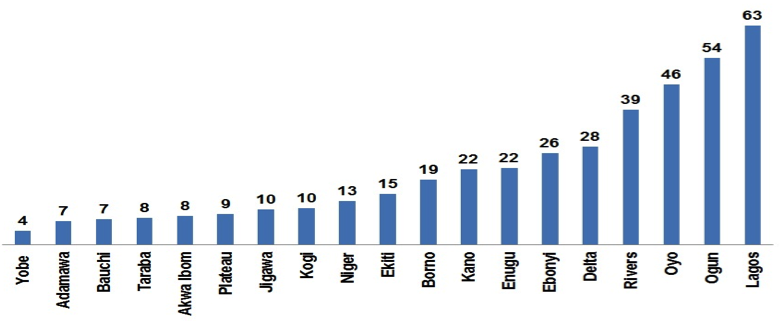
Fig. 1 IGR, as percentage of total revenue accrued to some Nigerian states in 2016 [1]
So, how can Nigeria reduce her poverty headcount ratio and achieve a sustainable economy? One of the most viable ways is the development of Nigeria’s unexplored bio-resources. This article seeks to present these resources – Jatropha and human poop – which can be referred to as the new ‘gold’ because of their economic potential. These resources are discussed below;
- Jatropha
The industrial sector and many homes depend mainly on gasoline and diesel oil to run their generating sets for electricity production. However, a new government regulation has mandated NNPC to ensure that gasoline and diesel oil are blended with bioethanol and biodiesel, respectively before they are released to the local market [3]. These new blends would be known as B20 and E10, in accordance with the “Bio-Fuel Policy and Incentives Document” [4]. E10 is a blend of 90% gasoline and 10% bioethanol while B20 is a blend of 80% fossil diesel and 20% biodiesel
[5]. This new regulation would ensure that the country fulfills its commitment to UN’s 2016 Paris Agreement to cut greenhouse gas emissions unconditionally by 20%, by 2020. Currently, one of the major telecoms company uses biofuel to run its base stations across the country [6]. Nigeria consumes 4.3 billion liters of fossil diesel annually. 876 million liters of biodiesel would be needed to achieve 20% blending with fossil diesel.
Jatropha is a flowering plant that produces oil-bearing seeds. Jatropha seed contains up to 40% of oil. Jatropha plant can survive anywhere in Nigeria without water for 8 months; its lifespan is 50 years and it can be intercropped with food crops. The cultivation of this ‘gold’ plant can be practiced by small-scale entrepreneurs and rural farmers, thereby reducing unemployment and poverty. In the first eight months of cultivation, about 500,000 naira or above can be earned by investors and farmers from two hectares of land. The earnings would be doubled or tripled by the end of the second year because the plant would have matured fully [6]. Jatropha seed cake also offers opportunity to produce bioethanol which is required to achieve 10% blending with gasoline in the E10 [6].
The value chain of Jatropha has the potential to generate 1.5 trillion naira annually from the blending of Jatropha-based bio diesel with fossil diesel, gasoline or kerosene. This value chain includes oil production from the seed; biodiesel and glycerin production from the transesterification of the oil; organic fertilizer and animal feed production from the seed cake; and local manufacturing of oil press. The Jatropha Growers, Processors and Exporters Association of Nigeria (JaGPEAN) already has plans to cultivate 100,000 ha of Jatropha farm nationwide in 2017 and 2.5 million ha within the next 5 years. However, this plan is grossly inadequate to meet the biodiesel demand projections for the future [7]. Therefore, the federal government has concluded plans to initiate a $50 billion Biofuels Equity Investment Fund (BIEF) for the development of the value chain of Jatropha [4]. This fund would be assessed at 5% interest rate by farmers and investors.
- Human feces
Currently, about 40% of the populace lack access to all forms of electricity. A significant chunk of the remaining 60% lacks access to regular electricity supply. The erratic power supply is caused mainly by inadequate transmission capacity and inconsistencies in the availability of natural gas. Most of Nigeria’s electric power plants are powered by natural gas [8]. Thermal energy from human feces is a suitable replacement for natural gas because it is more environmentally friendly and can eliminate environmental problems arising from open defecation of feces. Open defecation is responsible for thousands of deaths annually in Nigeria, particularly of children under the age of 5 [9]. Nigeria is one of the leading countries in the world with respect to open defecation (Fig. 2), with 46 million people defecating in the open [10]. According to the World Bank, about 75% of Nigeria’s rural population still lack access to improved sanitation facilities [2]. The economic impact of poor sanitation is about 1.3% of the country’s gross domestic product [11]. In fact, the first time that a local government area would be declared open defecation-free in Nigeria was 2016. However, Nigeria has a target of eliminating open defecation by the year 2025 through the provision of public toilets and utilization of feces as energy resource [9]. All the feces that are openly discarded can be collected and used for thermal energy production. The average human excretes 1.3 kg of poop per day [12]. Assuming 70% of Nigerians use the latrine per day, the total available poop per day would be 221,000 tonnes. This is a huge resource. The poop can be processed to thermal energy via the disinfection of the wet feces; drying of the feces; combustion of the dry solid feces; generation of steam by using the heat produced during the combustion of dry solid feces; and the use of the steam generated to run a turbine [13].

Fig. 2 Amount of people engaged in open defecation by country [13]
In conclusion, these two biomasses – Jatropha and human poop – are capable of contributing considerably towards the mitigation of the energy problem and reduction of the poverty rate in Nigeria.
References
[1] BudgIT Nigeria, Data, (2017). http://yourbudgit.com/.
[2] The World Bank, Data, (2015). data.worldbank.org (accessed April 20, 2017).
[3] M. Eboh, FG to cut fuel imports, grow Forex reserves with biofuels policy, Vanguard Newsp. (2017). http://www.vanguardngr.com/2017/02/fg-cut-fuel-imports-grow-forex-reserves-biofuels-policy/.
[4] M. Eboh, FG plans $50bn for local biofuels production, Vanguard Newsp. (2017). http://www.vanguardngr.com/2017/02/fg-plans-50bn-local-biofuels-production/.
[5] C. Olayinka, Nigeria targets 10% biofuel inclusion in petroleum products, Guard. Newsp. (2017). https://guardian.ng/news/nigeria-targets-10-biofuel-inclusion-in-petroleum-products/.
[6] S. Agbota, Jatropha: Gold plant catalysing Nigeria’s biofuel resolution, Sun Newsp. (2017). http://sunnewsonline.com/jatropha-gold-plant-catalysing-nigerias-biofuel-resolution/.
[7] O. Onwuemenyi, Nigeria needs 2.4m litres of biofuel daily – Group, Sweet Crude Reports. (2016). http://sweetcrudereports.com/2016/12/08/nigeria-needs-2-4m-litres-of-biofuel-daily-group/.
[8] A. Giwa, A. Alabi, A. Yusuf, T. Olukan, A comprehensive review on biomass and solar energy for sustainable energy generation in Nigeria, Renew. Sustain. Energy Rev. (2016). doi:10.1016/j.rser.2016.11.160.
[9] A. Enumah, Nigeria gets first open defecation-free LGA, Thisday Newsp. (2016). https://www.thisdaylive.com/index.php/2016/12/22/nigeria-gets-first-open-defecation-free-lga/.
[10] K. Guilbert, Nowhere to go: Nigeria’s crowded camps fuel disease fears from open defecation, Reuters. (2017). http://www.reuters.com/article/us-nigeria-bokoharam-idUSKBN15T1AR.
[11] UNICEF Nigeria, The situation, Water, Sanit. Hyg. (2017). https://www.unicef.org/nigeria/wes.html.
[12] C. Polprasert, Organic waste recycling, IWA Publ. Third Edit (2007).
[13] C. Weller, Bill Gates is helping India win its war on human waste. Here’s how, World Econ. Forum. (2017). https://www.weforum.org/agenda/2017/05/bill-gates-is-helping-india-win-its-war-on-human-waste-heres-how?utm_content=buffer2240b&utm_medium=social&utm_source=facebook.com&utm_campaign=buffer.

